Solid-lubricant bearings: what they are, benefits and applications
Insights
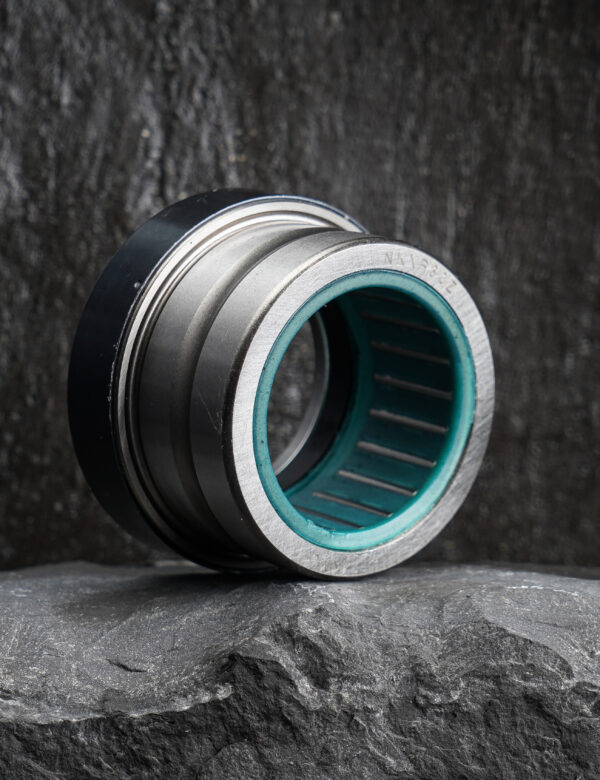
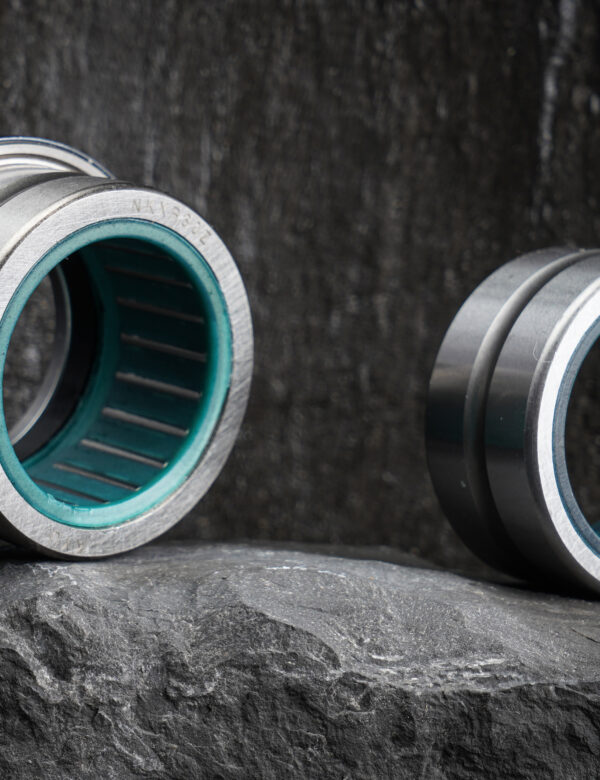
Solid-lubricant bearings (BPO, Bearing Plastic Oil) are rolling bearings in which the space between the rolling elements is filled with an oil-impregnated polymer that gradually releases lubricant during operation.
They prevent oil and grease leakage, offer resistance to contamination and chemical agents, and enable maintenance-free operation.
What is solid lubricant?
Along with oil and grease, solid lubricant is one of the solutions used to create a lubricating and protective film between moving surfaces.
Mainly composed of polymers, lubricating oil and additives, it appears as a solid plastic material at the macroscopic level, while under a microscope it reveals a microporous structure that, thanks to molecular forces, retains the lubricating oil within its pores.
During operation, factors such as acceleration, centrifugal force and rising temperatures promote the controlled release of oil from the micropores. The oil reaches the friction surfaces, ensuring proper lubrication. When operation stops, excess oil is reabsorbed by the polymer's porous structure.
This technology makes it possible to manufacture components and inserts in various shapes and sizes using dedicated moulds, including rods, rings, gears and sliders.
One of the main applications is BPO (Bearing Plastic Oil), a type of bearing incorporating solid lubricant.
These bearings are manufactured by injecting the polymer into the internal clearances of the bearing, where it solidifies and performs its lubricating function.
How do BPO bearings work?
In BPO bearings, the space normally left free between the rolling elements is filled with solid lubricant. Once solidified, it forms a body bonded to the cage and rotates together with it, progressively releasing the oil required for lubrication.
What are the advantages of solid-lubricant bearings?
Compared with bearings lubricated with oil or grease, BPO bearings offer several technical and performance benefits:
Elimination of the risk of lubricant leakage, which is typical of oil- or grease-lubricated bearings.
Improved performance at low temperatures, thanks to the solid lubricant polymer, which performs better than grease thickeners and allows BPO bearings to operate even at extremely low temperatures.
High resistance to chemical agents, due to the greater chemical inertness of the polymer compared with the thickeners commonly used in greases.
Reliable performance under demanding operating conditions, such as frequent starts and stops, bidirectional rotation, reciprocating movements (particularly small-amplitude, high-frequency oscillations), centrifugal forces and shock loads. These are all conditions in which conventionally lubricated bearings may be subject to premature wear.
High resistance to contamination, further enhanced by the use of shields, which help protect the bearing against the ingress of solid or liquid contaminants.
Improved corrosion resistance, as the solid lubricant creates an environment that discourages condensation from forming inside the bearing.
Longer-lasting lubrication and maintenance-free operation, thanks to an oil content that is 2–4 times higher than that of bearings with standard lubricant.
Where are BPO bearings used?
Thanks to their specific characteristics, JFK Group solid-lubricant bearings are used across a wide range of industrial sectors and in particularly demanding operating conditions.
Industry
Application requirements
Food, beverage, tobacco and pharmaceuticals
Lubricant leakage is not permitted; cleaning and high-pressure washing; acidic or alkaline detergents and sterilizing agents
Textile and dyeing industry
Grease leakage from bearings is unacceptable; chemical agents in the environment
Lifts
Frequent start-stop cycles; difficult disassembly and maintenance; need to prevent lubricant leakage
Agricultural machinery
Exposure to dust, mud, rain and large temperature fluctuations
Mountain biking and cross-country cycling
Dust, water and mud; variations in speed and load
Automotive paint systems
Water and paint mixtures in the environment; need to reduce maintenance downtime
Robotics
Complex movements; frequent start-stop cycles
Oil drilling
Exposure to weather and large temperature fluctuations
Port lifting equipment
Frequent start-stop cycles; exposure to weather and temperature variations; complex maintenance and replacement
Medical equipment
Intermittent operation; strict hygiene and contamination prevention requirements
Do you have an application where conventional bearings fall short?
Find out whether BPO technology could be the right solution for your application.
Insights, technical guides and news about mechanical components and the companies of JFK Group.
0 articles
There are no news articles in this category.
The news could not be updated.
Technical guides
Linear guides: types, how they work and how to choose the right one
Technical guides
Linear guides are precision mechanical components designed to provide controlled linear motion, with high precision and low friction.
These products are the ideal solution for industrial applications requiring the guidance and support of loads and moments in all directions.
Linear guides consist of ball or roller recirculating carriages that run along profiled, hardened rails, ensuring long strokes, zero play and repeatable positioning.
Structure and operating principle of linear guides
A linear guide mainly consists of three parts:
Carriage: the moving component that travels along the rail;
Rail: the linear element along which the carriage moves;
Balls or rollers: the rolling elements positioned between the carriage and the rail, enabling low-friction linear motion.
The guide can also be fitted with additional accessories, such as an integrated solid grease lubrication module. This innovative lubrication system consists of a lubricant-impregnated resin pad secured to the carriage end cap with two screws. What is the advantage of this module? During movement, the pad gradually releases oil onto the rail surface, ensuring continuous lubrication over an extended period.
Advantages of linear guides
Ball and roller recirculating linear guides offer numerous advantages, including:
high rigidity and positioning accuracy;
long service life and consistent motion precision;
fast and quiet movement;
dimensional interchangeability;
reduced maintenance requirements and easy lubrication;
high load-carrying capacity and moment resistance;
effective sealing and protection against dirt and contaminants.
Applications of linear guides
Thanks to their versatility and numerous advantages, these mechanical components are used across a wide range of industrial sectors, from machine tools to the food industry, industrial automation, medical and pharmaceutical applications, logistics, automotive and electronics.
Types of JFK linear guides
JFK linear guides are available in various configurations, designed to meet specific requirements in terms of load capacity, precision, space constraints and operating conditions.
JFK Group’s range of linear guides includes four main types:
GH standard series
GE low-profile series
GM miniature series
GR roller series
GH standard series – Ball recirculating linear guides
The GH series from JFK Group includes linear guides with four ball recirculation circuits and is considered the reference series for the most common industrial applications. Its structural design is optimized to ensure high load-carrying capacity, rigidity and positioning accuracy, also thanks to its integrated self-alignment function.
The GH series linear guides stand out for:
uniform load-carrying capacity in all directions, ensured by the 45° arrangement of the four recirculation circuits;
dimensional interchangeability;
high rigidity in all directions;
compact design and flanged configuration (also available with a long carriage for applications requiring high load-carrying capacity).
In addition to the GHH and GHW configurations, featuring compact and flanged designs, this product family also includes the GHL series, which differs from the previous configurations by its low-profile carriage, designed to reduce overall height.
GE low-profile series – Ball recirculating linear guides
The GE series four-circuit ball recirculating linear guides from JFK Group differ from the GH series thanks to their low-profile design, featuring a reduced height of both the carriage and the rail. This characteristic makes them particularly suitable for applications with limited installation space, where a lower load-carrying capacity is required compared to the GH series. Available with compact, flanged and short carriage configurations, the GEH and GEW linear guides ensure high rigidity in all directions, dimensional interchangeability and uniform load-carrying capacity, thanks to the 45° arrangement of the four ball recirculation circuits.
GM miniaturized series – Ball recirculating linear guides
The JFK Group's miniaturized GM series consists of linear guides with two recirculating ball circuits and Gothic arch-shaped raceway profiles, capable of supporting loads in all directions while ensuring precision and rigidity. Thanks to their compact and lightweight design, these guides are particularly well-suited for applications where a small footprint is a priority, despite having a lower load capacity than the larger series. Compared to the GMN series, the GMW miniaturized linear guides feature a carriage and a rail that are wider. This configuration allows for a significant increase in load capacity with respect to torsional moments.
GR roller series – Roller recirculating linear guides
The GR series linear guides from JFK Group use cylindrical rollers as rolling elements, significantly increasing rigidity and load-carrying capacity compared to ball recirculating versions. Featuring four roller recirculation circuits with a 45° contact angle, the GR series guides are available in both assembled and interchangeable versions. The range includes the GRH model, with a compact carriage, and the GRW model, with a flanged carriage. Their high rigidity and excellent load-carrying capacity make these components the ideal choice for heavy-duty applications involving high radial loads and significant bending moments. Compared to ball recirculating linear guides, rollers also distribute loads and stresses more effectively, ensuring high precision and positioning accuracy even under particularly demanding operating conditions.
How to choose a linear guide
Choosing the most suitable linear guide for a specific application requires evaluating several key parameters, including:
applied load
service life
space constraints
speed
duty cycle
precision
rigidity
In particular, the following aspects should be considered when selecting a linear guide:
Application field: identify the industry, machine type and specific operating conditions.
Precision class: select the appropriate class based on the accuracy required by the application.
Dimensions and space constraints: determine the guide cross-section, rail length and number of carriages required, taking into account the available space and the load to be supported.
Maximum applied load: calculate the nominal load and moments that the guide will need to withstand.
Preload: determine the preload value based on the required rigidity and the available mounting surfaces.
Service life: estimate the guide’s operating life by considering speed, duty cycles and operating conditions.
Lubrication: choose the most appropriate lubricant (grease or oil) and assess the presence of dust, contaminants, moisture, high temperatures or other environmental factors that may affect the linear guide’s operating conditions.
Self-lubricating bushings vs. relubricable bushings: how to choose
Technical guides
Tell me where you'll use it, and I'll tell you which bushing to choose! That's right: one of the key factors in choosing the most suitable bushing is the application it will be used in.
In short, self-lubricating bushings are ideal when maintenance needs to be kept to a minimum or when the lubrication point is difficult to access. Relubricable bushings, on the other hand, are suitable when periodic lubrication can be scheduled and the application operates under demanding conditions, with exposure to shock loads and contaminants.
The operating conditions a bushing is subjected to have a significant impact on its performance and service life. Loads, sliding speed, vibrations and shock loads, temperature, exposure to contaminants or chemical agents, and the possibility of relubrication: every application has specific operating conditions that can affect a bushing's performance and long-term durability.
That's why there is no one-size-fits-all solution. Choosing the right bushing for the specific application makes all the difference in terms of reliability, efficiency and maintenance costs.
Self-lubricating solutions are particularly suitable when the aim is to reduce maintenance or when access to the component is difficult. Relubricable bushings, on the other hand, allow lubricant to be replenished and may be the preferred choice for applications requiring scheduled lubrication.
In this article, we'll explore the different types of DJA MOND self-lubricating and relubricable bushings from JFK Group, highlighting their features, advantages and main applications to help you identify the most suitable solution for your needs.
Self-lubricating bushings: types and applications
Dry-running self-lubricating bushings with solid lubricant inserts
These sliding components require no lubrication and are suitable for heavy loads and low sliding speeds. They consist of a solid body with solid lubricant inserts based on graphite and/or PTFE. The body can be made of copper alloy (BG.. series), steel (AG.. series) or cast iron (CG.. series). During operation, the solid lubricant forms a thin film that covers both surfaces, preventing direct metal-to-metal contact. Dry-running self-lubricating bushings with solid lubricant inserts are used in a wide range of applications. Depending on the material, they can be found in sectors ranging, for example, from the food industry to crane support systems.
Multilayer self-lubricating bushings with PTFE composite
Also known as dry bearings, DJA MOND PT..SL bushings consist of a low-carbon steel backing, a porous bronze layer and a self-lubricating PTFE layer. Thanks to this PTFE layer, they are maintenance-free, suitable for high sliding speeds and offer good frictional properties, with low wear and high load-bearing capacity. Multilayer self-lubricating bushings with PTFE composite are used across a wide range of industries, from household appliances to the automotive industry, and from the pharmaceutical sector to the food industry.
Sintered bronze and iron bushings
Sintered self-lubricating bearings are manufactured using the most modern and advanced powder metallurgy processes. Featuring a controlled porous structure, BZ../FE.. sintered bushings are oil-impregnated, gradually releasing lubricant during normal operation to form a self-lubricating film. They are generally suitable for applications involving high rotational speeds and low loads.
Engineering plastic bushings
EPB.. series engineering plastic bushings offer a versatile and efficient solution for industrial applications requiring low weight, reduced maintenance and good wear resistance. Made from EPB.. engineering plastic, they are widely used in applications involving light to medium loads and operating temperatures below 80°C. Compared with traditional metal solutions, engineering plastic bushings offer high resistance to corrosion, moisture and many chemical agents, making them particularly suitable for harsh environments and applications where improved operational cleanliness is required.
Fiber bushings
The outer material of the FWB.. series fiber bushings consists of high-strength glass fibers reinforced with epoxy resin, while the lubricating layer is made of PTFE-wrapped fibers or special lubricating fibers. This structure has been specifically designed to provide exceptional wear resistance and a low coefficient of friction under high-load, low-speed operating conditions.
Relubricable bushings: types and applications
Multilayer relubricable bushings with POM
POM plain bearings can be considered pre-lubricated because they require only a minimal amount of lubricant to operate optimally over an extended period. They consist of a low-carbon steel backing that provides mechanical strength. The porous sintered bronze layer is impregnated and coated with POM (or PEEK), with pockets formed on its surface to retain grease and collect any impurities that may get between the shaft and the bushing. The PT..RK series multilayer relubricable bushings with POM are suitable for applications requiring minimal maintenance and involving severe operating conditions. Particularly suitable for rotational and oscillating movements, they have low sensitivity to edge loading and are water-repellent. They also offer good damping properties, making them resistant to impact loads. The pockets on their surface make them ideal for applications operating in dirty environments where continuous or frequent lubrication is not possible (e.g. agricultural machinery, construction equipment and material handling applications in general).
Case-hardened bushings
The BAC.. case-hardened bushings are designed for applications requiring high wear resistance, load-carrying capacity and a long service life, even under demanding operating conditions. Thanks to the case-hardening treatment, the bushing surface achieves high surface hardness while retaining a tough core, capable of absorbing impacts and mechanical stresses. The specific manufacturing process used for these bushings ensures excellent wear and anti-seizure performance, guaranteeing reliability, operational precision and continuous operation even in the most demanding industrial applications. The low surface roughness achieved after machining also helps reduce the coefficient of friction, improving efficiency and smoothness of movement. After initial greasing, the BAC.. case-hardened bushings allow relubrication intervals of up to 550 hours, depending on operating conditions and the application environment. The range includes various standard types designed to meet the requirements of the most common industrial applications, including material handling systems, automation, mechanical power transmission and industrial machinery.
Wrapped bronze bushings
This type of bushing is made of tin bronze, a material that ensures high resistance to wear, seizure, high temperatures and corrosion, as well as a high fatigue limit. The DJA MOND PBC.. series wrapped bronze bushings are particularly distinguished by their thin walls. Thanks to this feature, for the same shaft diameter and operating loads, they require less installation space than a machined bushing or a bearing. The sliding surface is machined and features either diamond-shaped indentations (PBC..AR) or through-holes (PBC..FP), which increase lubricant storage capacity, or diamond-shaped indentations filled with solid lubricant (PBC..ARG). Wrapped bronze bushings are the ideal choice for machinery operating in the presence of contaminants, impacts and/or vibrations, such as agricultural machinery, lifting equipment, construction machinery and similar applications.
Bimetallic Bushings
The BJ.. bimetallic bushing consists of a steel backing, which provides high load-carrying capacity and excellent heat dissipation, and a sintered bronze powder layer, which ensures good wear resistance and allows the bushing to withstand high sliding speeds. Upon request, the outer surface can be coated with a 2 μm layer of copper, providing good corrosion resistance. Thanks to these characteristics, this type of bushing is used in the automotive industry, for example in petrol and diesel engines, pumps, industrial and agricultural machinery, lifting equipment, air conditioning systems, compressors, vehicle gearboxes, reduction gears, leaf springs, stabilizers for heavy-duty vehicles, and other applications.
DJA MOND bushings comparison table
Bushings comparison table
Application characteristics
Self-lubricating bushings
Relubricable bushings
Multilayer bushings with PTFE composite
Dry-running bushings with solid lubricant inserts
Sintered bronze and iron bushings
Engineering plastic bushings
Fiber bushings
Multilayer bushings with POM
Case-hardened bushings
Wrapped bronze bushings
Bimetallic bushings
Series PT..SL
Series BG../AG.. /CG..
Series BZ../FE..
Series EPB..
Series FWB..
Series PT..RK
Series BAC..
Series PB..
Series BJ..
High loads
Good
Excellent
Unsuitable
Unsuitable
Excellent
Excellent
Excellent
Suitable
Suitable
High speeds
Good
Suitable
Excellent
Unsuitable
Suitable
Good
Excellent
Suitable
Suitable
Low friction
Excellent
Good
Good
Good
Excellent
Excellent
Unsuitable
Unsuitable
Unsuitable
High temperatures
Good
Excellent
Unsuitable
Suitable
Good
Suitable
Excellent
Good
Good
Suitability for dirty environments
Unsuitable
Good
Suitable
Excellent
Good
Suitable
Unsuitable
Excellent
Excellent
Corrosion resistance
Suitable
Good
Suitable
Excellent
Excellent
Suitable
Unsuitable
Good
Suitable
Misalignment tolerance
Unsuitable
Good
Suitable
Good
Good
Suitable
Unsuitable
Suitable
Suitable
Operation with reduced clearance
Excellent
Excellent
Suitable
Unsuitable
Good
Good
Excellent
Suitable
Suitable
Response to vibration and shock loads
Suitable
Excellent
Suitable
Good
Good
Excellent
Excellent
Good
Good
Self-lubricating or relubricable bushings: which should you choose?
There is no single type of bushing that is best for every application. The choice depends on the operating conditions and the specific requirements of the application.
Self-lubricating bushings may be the right solution when maintenance interventions need to be reduced, when the component is difficult to access, or when the application requires operation without relubrication.
Relubricable bushings, on the other hand, allow the lubricant to be replenished during operation and may be particularly suitable for applications where maintenance can be scheduled or where operating conditions require periodic lubrication.
To identify the most suitable solution, it is therefore necessary to assess the type of movement, load, speed, temperature, operating environment and planned maintenance intervals.
Not sure which bushing to choose for your application?
Load, speed, temperature, type of movement and environmental conditions are just some of the parameters to consider.
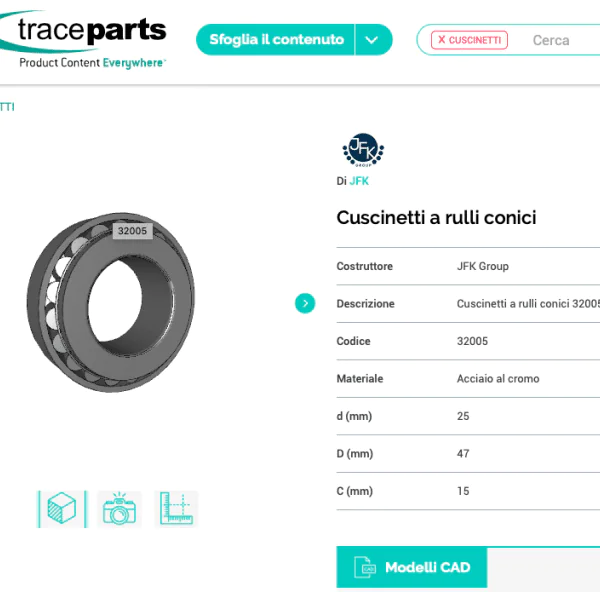
TraceParts platform represents one of the world’s leading digital content portals, with more than 5.5 million engineers and designers from more than 195 different countries.
Our choice for the digitization of JFK Group
A key reference for the engineering, industrial equipment and machine design industries, TraceParts provides access to more than 2078 supplier-certified product catalogs and billions of 2D drawings, 3D CAD models and product data sheets.
TraceParts has been our choice for:
the comprehensiveness of the products and services it offers;
its widespread presence in strategic areas of our interest;
the seniority it boasts in this world.
Another element that made us lean toward this platform is the simple, intuitive, and user-friendly graphical interface.
A valuable aid for engineers and designers
In recent years, digitization has transformed the way companies interact with their customers, offering new opportunities to access products and services. With this in mind, as JFK Group, we have decided to putting our components online, with the aim of ensuring an valuable additional service and, at the same time, expand our presence on a strategic touchpoint, reaching out to profiled users and intercepting new prospects in line with the company’s target audience.
In addition to increasing the visibility and accessibility of our offerings, we believe that digitizing products and related documentation can be a concrete support for professionals.
In particular, the ability to access an online database enables to:
simplify the design phase, offering complete and detailed files that are useful for the evaluation of overall dimensions and integration into designs;
pptimize work timelines, reducing research and speeding up decision making;
improve internal operations, providing immediate access to up-to-date data sheets and documentation.
Certainly, the ability to offer current and potential customers a product configurator that can help them in the implementation phase of their projects is an added value. In fact, it allows us to identify and respond in a timely and effective manner to the needs expressed by the user based on their specific requirements.
Digital innovation is not only a competitive advantage, but also an opportunity to improve the user experience and quality of service provided to our customers.
JFK Group: not mere suppliers, but true consultants
Providing technical data sheets and CAD models of components to designers, then, allows us to have a privileged channel of access to companies, make ourselves known and propose ourselves not only as simple suppliers, but as consultants and partners able to support customers in finding the solution best suited to their needs.
In a reality like today's, marked by great competitiveness and, at the same time, market saturation, it becomes essential to distinguish one's product offering from that of competitors.
We believe that online cataloging is a key lever to enhance our proposition and offer concrete added value to our clients.
Bearings, bushings, linear guides, plain bearings and rod ends… Want to find out more about our range of components?
CCZ International's management system complies with ISO 9001:2015 requirements.
This is an important achievement that represents further confirmation of the path of growth and improvement undertaken by our company. The certification was issued by SGS Italia, a third-party body recognized by Accredia and a world leader in the verification, analysis and certification of goods, services and systems.
Let's find out more together what it is all about.
WHAT IS ISO 9001 CERTIFICATION
ISO 9001 is the international standard that guarantees the quality of products, services and systems to protect consumers.
What is the objective pursued? The continuous and constant optimization of the organizational structure and the pursuit of customer satisfaction.
The standards and guidelines were developed by the International Organization for Standardization (ISO).
This standard provides a process approach: every operation of the company is considered as a process. For this, a global map is created in which all the processes occurring within that particular reality are identified, their sequence, interconnection and interaction, and related inputs and outputs.
Following the Plan-Do-Check-Act approach, continuous improvement is aimed at through process planning, implementation, control, analysis and evaluation.
THE BENEFITS OF CERTIFICATION
There are numerous benefits of adopting ISO 9001:2015 certification within your company. Here are some of them:
increased credibility and strengthening of the company's image in the international arena;
timely satisfaction of customer requirements and expectations and, consequently, customer loyalty to the company with an even closer relationship;
increased productivity and efficiency through precise mapping, constant monitoring and careful analysis of internal processes with a view to growth and continuous improvement;
greater staff involvement and more clarity of roles, responsibilities and growth paths;
possibility of taking part in public contracts and tenders as the ISO 9001 standard is now a mandatory requirement in many sectors.
As the English poet John Donne wrote, "No man is an island, complete in himself; every man is a piece of the continent, a part of the whole." With this in mind, CCZ International (part of JFK Group) has decided to take an active part in the "San Giuliano Milanese – Positive Impact City" project.
A project for the common good
More than 700 Italian municipalities are participating in the "Positive Impact Cities" initiative, conceived by PMG Italia Società Benefit. The goal is to involve the Third Sector, Businesses, Institutions and Citizens in promoting an inclusive culture based on social equity, common good and responsibility.
The main fields of action of the project include:
Environment
Inclusion
Socialization
Health
Care for the elderly and frail
Civic education
San Giuliano Milanese: a network of collaboration
For the City of San Giuliano Milanese, the project sees collaboration between:
Municipal Administration;
Fondazione Luigi Clerici;
Auser, a volunteer and social promotion association that promotes active aging and solidarity between generations.
Auser is committed to improving the quality of life of the elderly and frail by accompanying them to hospitals, day care centers and schools, valuing their experiences and promoting moments of exchange with younger people.
Social transportation and education: the two main initiatives
The program of "San Giuliano Milanese – Positive Impact City" is developed through two key initiatives:
Social transportation for people with disabilities
Training path for students
Cristina Zoccali, PMG Italy's contact person for the project, stresses:
"Positive Impact City represents a first concrete step toward a change in favor of our area, an investment in the young people who will be tomorrow's new entrepreneurs and parents, in our grandparents who worked hard so that we could enjoy an imperfect but wonderful place today, in all those people in great physical and mental difficulty who need us to be more serene and autonomous. Because welcoming differences and diversity is something that should be valued and supported."
A vehicle equipped for inclusion
CCZ International will participate by providing on loan for free use a Ducato Maxi van equipped to transport people with disabilities. This vehicle will enable them to reach health facilities, attend medical and specialist visits or take part in socialization activities in safety and comfort.
A contest for young people and scholarships
In parallel, the project includes a training course aimed at students of the Luigi Clerici Foundation. During the course, topics related to Sustainable Development and the UN 2030 Agenda will be explored. The students, divided into groups, will have three months to identify a need in the city related to:
Social inclusion
Eco-sustainability
Redevelopment of environments
From this analysis, they will develop a project proposal. A committee composed of the School, the City, the Sponsors and PMG Italy will evaluate the best ideas, awarding scholarships to the winners.